Having maintained our AAA bond rating last year, our county government continues to cut our budget as property values continue to fall. We will have to cut 16 million dollars from the county budget for 2013. The article below from the Macomb Daily references the recent quarterly submitted to the Board of Commissioner from the finance department. People can look at the Macomb County’s financial information on line at www.macombcountymi.gov. As the Finance Chairman for the Board of Commissioners continue to look for new and innovative ways to shrink the size of county government, without raising taxes.


Friday, January 27, 2012

By Chad Selweski
Macomb Daily Staff Writer

Macomb County government remains frugal heading into 2012 and may have established a head start in ridding the budget of a projected $16 million deficit next year.

Though no definitive projections can be made, the latest fourth quarter fiscal reports from 2011 show a flattened trajectory that may indicate good news as the new year progresses.

“You will see the fruits of our labor once more numbers come in,” said Pete Provenzano, county finance director.

The quarterly report, which is now required by the county charter, shows that many departments have kept their salaries and fringe benefits below projections. With hiring freezes and attempts to reduce expenses through employment attrition, rather than layoffs, several departments kept their 2011 payroll costs 10 percent or more below projections.

Those departments include: Probation, Probate Court, Family Court, Finance, Property Equalization, Purchasing, Facilities and Operations, and the Health Department.

Controlling wages and benefits is key to bringing the budget under control because they represent about 70 percent of the county’s expenses.

In 2012, more savings will be realized as the county has secured cost-saving contracts with 23 of the 26 unionized employee units, and a 24th has reached a tentative agreement.

Those concessionary contracts, following in the footsteps of the one-year 2011 pacts, require hiring freezes, pay freezes, higher out-of-pocket health care costs for some employees, a halt to “longevity” payments, and unpaid “furlough days.”

For 2012 the budget is balanced, thanks to $23 million in cuts. The general fund stands at $193 million, a decrease of $6 million, or 3 percent less spending.

The entire budget, including the Department of Roads and all programs financed by state and federal dollars, stands at $614 million.

A huge projected deficit for 2013 looms, largely due to another year of falling property tax revenues caused by the collapsed housing market.

At the same time, Provenzano cautioned that overall expense reports from the departments showing a substantial improvement in cost-cutting for the 2011 fourth quarter are misleading. Many of those figures represent an incomplete final tally for the past year.

Because of the lag time experienced with regard to bills coming in and accrued expenses being recorded, keeping close tabs on spending patterns can be a challenge, Provenzano said.

“A lot of this,” he added, “is more art than science.”

URL: http://www.macombdaily.com/articles/2012/01/27/news/doc4f2224cf86500582189053.prt

© 2012 macombdaily.com, a Journal Register Property

{ 0 comments }

The Macomb County Board of Commissioners is working with our County Clerk Carmella Sabaugh to allow for greater ease to follow your county government on line. Below is expert of a recent announcement on the subject. 


Macomb County Clerk Carmella Sabaugh announced today that roll call votes, motions and unofficial minutes for tomorrow’s Macomb County Commission meeting will be viewable as they are typed in real-time on the Web using Google Docs.  The Commission’s organizational meeting is scheduled for Tuesday, January 10, 2012 at 9 a.m.  To follow the text of the proceeding Tuesday morning, see: http://www.macombcountymi.gov/clerksoffice.  

In addition to promoting transparency, Sabaugh says an advantage will be that county commissioners have the opportunity to see the text of motions as they are made, which can make motions clearer during meetings and reduce administrative time required to reproduce motions.  A motion made by a commissioner and typed by the clerk would be instantly available to all commissioners who wanted to view it on their phones, laptops or other devices.  Sabaugh says another advantage will be the ability of her staff to detect corrections more quickly because “more eyes will be looking.”

Unofficial meeting minutes are normally not published on the Internet until the end of a commission meeting or the next day.  Minutes are not official until adopted by commissioners at a subsequent meeting.

This will be the first time unofficial Macomb County Commission meeting minutes are made available in real time to the public using a Google Doc.  Sabaugh said tomorrow’s agenda is light and no controversy is expected, making the meeting perfect to test a new innovation. Sabaugh directed her staff to find out if it would be helpful to offer this service for other meetings and commissions and to work out a process.

There is no additional cost for this service because it is part of the clerk’s Google Apps for Government suite.  The county has over 400 Google Apps users.  The clerk/register of deeds, court staff and County Executive Office recently renewed Google Apps for Government licenses for their departments.  The county has approximately 1,500 non-Google E-mail accounts and 417 Google licenses.

{ 0 comments }

Tuesday, November 29, 2011

By Chad Selweski
Macomb Daily Staff Writer

Move will help erase $5 million budget mistake

County officials are preparing to transfer three health care programs to a local charity as part of a fiscal reclamation project to repair a $1.7 million hole in the 2011 budget.

After a multiyear, $5 million mistake in previous budgets was discovered, the Board of Commissioners has proceeded with an accounting fix and a move to fire their auditing firm. But that has still left the county’s relationship with Macomb Health Plan, which provides medical care to indigents, up in the air. The county books had wrongly indicated that MHP owed the county $5 million.

On Tuesday, the commissioners appeared ready to grant final approval to transfer to MHP three programs: breast and cervical cancer screening; senior citizen counseling services; and prescription drug provisions for those without insurance coverage.

Turning those programs over to the MHP would remove $1.2 million of the budgeting error. A $500,000 reduction in funds to help with “charity cases” at local hospitals will provide the remaining funds needed to fix the $1.7 million in anticipated revenues that don’t actually exist.

The programs will be provided, through a “seamless transition,” at the new MHP office/clinic located at the Clemens Center in downtown Mount Clemens, according to officials. The charitable agency currently employees 20 workers and expects to hire at least 1-1/2 more employees before the transfer takes effect Jan. 1.

“We have a very qualified staff. We … will look at their duties and see how they fit into this transition,” said Patty Kukula, a founder of MHP.

The breast and cervical cancer screening program, which has already detected 70 tumors in recent years, will service about 1,300 low-income women per year between the ages of 40 and 64.

The senior counseling program will provide therapists in individual and group settings for 700 seniors a year.

The Prescription Resource Network program will continue to assist poor seniors with securing free prescription drugs from pharmaceutical companies that offer charity distributions. PRN will service about 70 clients annually.

County officials were stunned earlier this month when they learned that approximately $5 million in “receivables” from MHP had been incorrectly listed as actual cash revenue from 2006-10. The ensuing bookkeeping solution called for re-issuing the county’s 2010 financial statement with $3.7 million in “invisible” revenues replaced with an allocation from the county “rainy day” fund.

The changes discussed by the board’s Finance Committee on Tuesday consisted of a phase two fix.

Some commissioners were skeptical of the three program transfers because the Office of the County Executive had assured that many workers slated for layoff at the Senior Citizen Services agency would be hired by MHP.

The nonprofit is not providing any guarantees but county Finance Director Pete Provenzano said job losses will be minimal.

Three employees scheduled for layoff at the breast and cervical screening program, currently overseen by the county Health and Community Services Department, will be offered transfers to new jobs within the department.

A full-time counselor facing layoff from Senior Citizen Services is likely to land a position with MHP.

And a full-time worker for PRN has “bumping rights” under a union contract that allows her to maintain employment with the county.

Yet, some commissioners were still not satisfied that such major alterations were needed if they didn’t help balance the budget — except on paper.

“I’m not sure how transferring these (programs) benefits Macomb County. I’m not sure how there is really any savings here,” said Commissioner Kathy Tocco, a Fraser Democrat. “I’m now of the opinion this is being done just to clean up accounting messes.”

The overall budget proposed for 2012 by County Executive Mark Hackel eliminated a $23 million projected deficit and features a small surplus.

On a yearly basis, about 12,000 Macomb County residents rely upon MHP as the health care provider of “last resort.” The program provides primary care by physicians, “urgent” care and diagnostic services.

The bulk of MHP’s clientele come from Warren, Sterling Heights, Clinton Township and Roseville. They largely consist of the long-term unemployed who cannot qualify for Medicaid.

The changes discussed on Tuesday have already been built into the proposed 2012 budget by Provenzano.

The budget — and the agreement with MHP — faces final approval from the commissioners on Dec. 13.


URL: http://www.macombdaily.com/articles/2011/11/30/news/doc4ed5963ab3738288931751.prt

© 2011 macombdaily.com, a Journal Register Property

{ 0 comments }

News


MacombCounty

Board of Commissioners   


Macomb County ,Mich.— The Macomb County Board of Commissioners adopted an ordinance establishing a standard of ethics for all public servants in the county at its full board meeting Thursday. This makesMacomb the  largest county inMichiganto have such a code of conduct, and the only county in the tri-county area.

 
The ordinance, required under the new county charter which took effect January 1, defines a public servant as “an employee, county-wide elected official, commissioner, or appointee.” According to Commissioner Fred Miller, who chaired the Ethics Ordinance Ad Hoc Committee, the 10-page document cracks down on issues such as nepotism, gifts and gratuities, and the inappropriate use of county time and property, while setting tough guidelines for disclosure to prevent conflicts of interest within the county.

 
“I’ve been proud to play a role in writing Macomb County’s first ethics ordinance,” Miller said. “I believe it will help establish a culture of accountability and transparency that the people of Macomb County deserve.”


Commissioners Ray Gralewski, Kathy Tocco, Toni Moceri, Bob Smith and Board Chair Kathy D. Vosburg also served on the committee, which met over several months to refine the document and consider similar ordinances and models from the State Attorney General’s office, the Michigan Municipal League, and guidelines set in theMacombCountycharter.
“Not only have we fulfilled our obligation under the charter with this ordinance, but it also reflects the integrity and code of conduct which the public expects from its officials,” Board Chair Kathy D. Vosburg said.    


###

For more news from the Macomb County Board of Commissioners, check www.MacombBOC.com

or visit us on Facebook or @MacombBoC on Twitter

{ 0 comments }

Macomb Orchard Trail Opens its Final Paved Leg

by Don Brown on October 6, 2011

 BRUCE TOWNSHIP, Mich. — A much anticipated project will be celebrated on Tuesday October 11th as community leaders marked the opening of the final paved leg of the Macomb Orchard Trail from Bruce Township to Richmond.

 The non-motorized, hike and bike path is a 24-mile linear park which starts at 24 Mile Road and Dequindre in Shelby Township and travels northeast to the City of Richmond. The property, formerly owned by the Canadian National Railroad, was purchased by the county in 2001 for $3.5 million.

 “This marks a milestone for the county,” said Macomb County Commissioner Don Brown, who was a principle advocate for the trail from its inception in 2002, and also serves on the Macomb Orchard Trail Commission. “It has been an extensive undertaking, but I am proud to say that we now have a 24-mile paved trail that is accessible for enjoyment to persons of all ages and abilities.”

Brown said Trail Commission is continuing plans to improve amenities along the trail with rest stations, additional parking, and access points to the trail in Shelby, Washington, Romeo, Armada and Richmond.

 Please see the attached fact-sheet for more information on the trail.

 For a trail map, visit: www.macombcountymi.gov/macomborchardtrail/map.htm

###

                For more news from the Macomb County Board of   Commissioners, check www.MacombBOC.com

or visit us on Facebook.


 Brief History of the Trail

In 1998, the Canadian National Railroad put up for sale a 24-mile section of railroad for $5.4 million.

In 1998, the Friends of the Macomb Orchard Trail (FOTMOT) group was formed. Their mission became converting the abandoned railroad corridor into a trail and set about building community support and raising money for the purchase and development of the trail.

The FOTMOT rallied the support of leaders from several of the communities located along the trail. This group then asked the Macomb County Board of Commissioners for help in purchasing the trail. Macomb County negotiated with the railroad company and finally bought the corridor for $3.5 million dollars. 

In 2001, the “Macomb Orchard Trail Commission” (MOTC) was formed. They were given the responsibility of developing and providing ongoing maintenance for the trail. Members include representatives from three of the eight municipalities through which the former railway runs, a county commissioner and a member of the Huron-Clinton Metropolitan Authority.

In 2002, a master plan for the trail was created. The goal of the plan was to provide a safe and attractive trail for users.

In 2003, an engineering firm was hired to prepare specifications for developing Phase I of the Macomb Orchard Trail. This six-mile stretch begins at 24 Mile Road and Dequindre in Shelby Township and ends at 29 Mile Road and Van Dyke in Washington Township. The project was completed in the summer of 2004.

In 2005, The Macomb Orchard Trail Commission began engineering of the final 17 miles of trail. This construction project included asphalt trail from Washington Township to Romeo and from Armada Ridge and 33 Mile Road to downtown Richmond.  In between these two areas the trail remained in stone.

In 2007, The Macomb Orchard Trail Commission had a grand opening of the Richmond Gateway Park.

In 2008, the bridge over M-53 which made a safe crossing over this busy boulevard stretch of road.

In 2010-2011, the trail between Armada Township and the City of Richmond was asphalted and the bridge over the North Branch of the Clinton River was rehabilitated at a cost of $1,132,636.

 The completion of the bridge over the North Branch of the Clinton River is similar to the “golden spike” as the ability to cross this river valley connects the east and west segments of the trail.

 To be continued…


{ 0 comments }


MOUNT CLEMENS, Mich. — The Macomb County Board of Commissioners Finance  Committee this week exercised oversight on county funds by approving a nearly $360 million budget for Special Revenue and Enterprise funds, and by passing an ordinance outlining the authority given to County Executive Mark Hackel to make budgetary line items transfers.


The ordinance gives the Executive authority to transfer funds in an amount of up to $30,000 or 2 percent of a fund, whichever amount is less. Transfers of any amount over this require prior approval from the Board of Commissioners.


”Because the Board is charged with oversight of the county budget, this is a necessary step in the process of accountability and transparency,” said Chair of the Finance Committee, Commissioner Don Brown. “We worked in conjunction with the Office of the County Executive to come up with an amount we agreed upon, which would also allow the Board to ensure taxpayer funds are spent wisely.”

###


{ 0 comments }

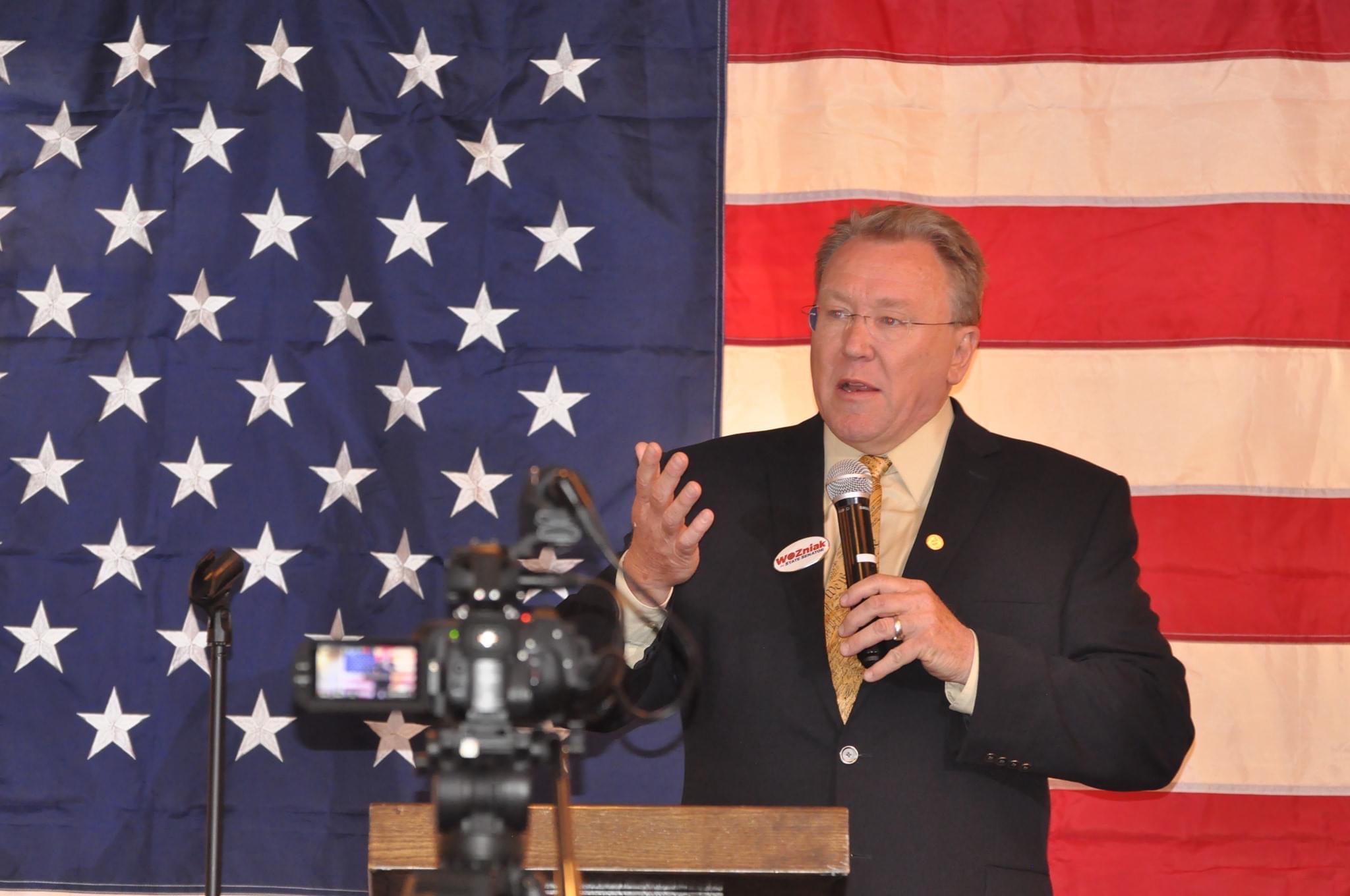
Commissioner Don Brown speaks to Romeo Area Tea Party

by Don Brown on September 7, 2011


Click here for Commissioner Don Brown’s remarks video taped  by RATP.

{ 0 comments }

Recently Macomb County Government retained it’s AAA bond rating for it’s financial management and now our Pension fund receives high marks for it’s management.  Both of these reports are good news for taxpayers.


MOUNT CLEMENS, Mich. — Despite a tumultuous economic landscape nationwide, the pension board overseeing Macomb County’s $788 million Employee Retirement System has learned the system continues to maintain a very healthy, fullyfunded status.  According to actuary Gabriel Roeder Smith & Company, the pension system is currently funded at 103.1percent — this means that for every $1 in liabilities owed to employees and retirees, there is $1.03 in assets invested to cover that liability.


“This is great news, and it reaffirms how carefully the pension board considers its investments and how seriously it takes its fiduciary responsibility in overseeing our employee and retiree pensions,” said Kathy D. Vosburg, chair of the seven member Retirement Commission who also serves as Chair of the Macomb County Board of Commissioners.  As further evidence of the effective management of the system, the employer contribution only increased by 3.45 percentfrom last year.  “Controlling the costs associated with providing benefits to our employees creates a positive impact on our $600 million budget, because as a service provider, our largest cost is personnel,” said Macomb County Finance Director Peter Provenzano.


The steps Macomb County has taken over the years have helped the pension fund weather recent financial storms with flying colors, unlike many other counties in Michigan.  “This funding ratio places Macomb County in a small group of pension plans around the state,” said Cathy Nagy of Gabriel Roeder Smith & Company. “There are very few plans experiencing an overfunding status.”


The county’s plan covers approximately 1,800 pensioners.  “In a time of declining revenues and concern over the future, the county is proud of the accomplishments of the Retirement Commission, and the safety and security it offers to its employees as they continue to serve the county,” noted Macomb County Executive Mark Hackel.


                                                                                                                ###


REL110808


{ 0 comments }

Macomb County’s Financial Dash Board

by Don Brown on August 23, 2011

As another step in his pledge to improve financial stability, accountability and transparency, Macomb County announced that the County is now presenting detailed County financial information in a user-friendlier manner on its website. The county is collaborating with Munetrix, a web based information source that provides easy-to-understand access to sometimes confusing financial information for municipal governments. Macomb becomes the first county in the state to implement the tool in a comprehensive format.

Munetrix has created the County’s financial “dashboard” on www.macombcountymi.gov . The dashboard will include the previous four years of officially audited financial information, the current-year budget and future-year forecasts. The dashboard went live Friday, July 15, 2011.

We’re pleased to be partnering with Macomb County in implementing the Munetrix municipal metrics tool,” stated Bob Kittle, Co-Founder of Munetrix, LLC. “It’s exciting to see communities like Macomb being proactive and embracing a system like ours that will document their fiscal position well in advance of the Governor’s October 1, 2011 compliance requirement for Transparency. Munetrix has dynamic software that presents our financial information in charts and graphs that people who don’t have accounting backgrounds can easily comprehend and understand,” Citizens can go to our website and get a thorough illustration of Macomb County’s financial position. The dashboard will help citizens gauge how their AAA rated County government is performing.

{ 0 comments }

Commissioner Don Brown to Speak at Romeo Tea Party

by Don Brown on August 18, 2011

County Commissioner Don Brown will speak this Monday evening May 22 at 7:00 pm at the Romeo Tea Party’s monthly meeting at the Capital Banquet Center in Washington Township. Commissioner Brown will discuss the responsibilities of a Commissioner, the status of several projects he has been working on for his constituents in northern Macomb and progress on the transition to the voter approved County Executive form of government.

{ 0 comments }